
Federal hemp update · November 19, 2026
Your favorites are staying.
Only the THC is leaving.
New federal hemp limits are scheduled to take effect December 11, 2026 unless Congress changes the law. Many THC-containing full-spectrum hemp products would no longer qualify as federally lawful hemp—including finished products above the new 0.4 mg-per-container limit.
Here’s what’s changing, what stays the same at balenceCo, and how the new extracts compare. Learn more below ↓
Your balenceCo products
What stays the same. What changes.
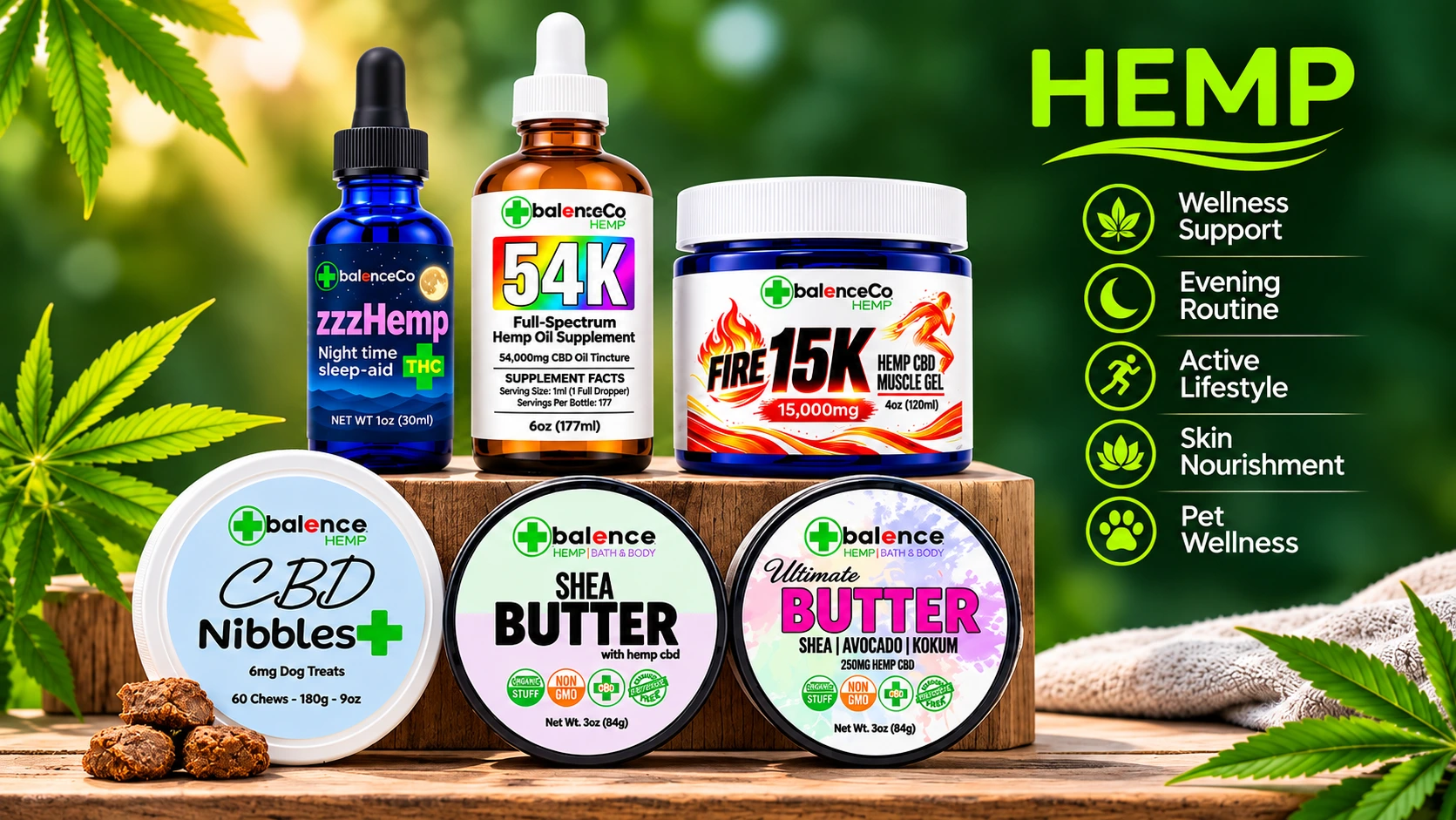
Our full-spectrum tinctures and FIRE muscle gels are getting an extract update—not a new product lineup.
Your familiar products.
- Product offerings — no reduction to the lineup
- CBD milligram strengths — same labeled CBD amounts
- Bottle and jar sizes — unchanged
- Other ingredients — the established base formulations remain
The hemp extract.
Broad Spectrum keeps a range of minor cannabinoids; CBD Isolate is purified CBD only. We will choose the extract appropriate for each product.
Removing THC changes the extract’s cannabinoid profile, so the updated products cannot be chemically identical to their full-spectrum predecessors.
The Laws
What changes—and when?
Congress passed a tighter federal definition of hemp in 2025, then delayed most of its requirements in 2026. [1] [2]
Public Law 119-37, Section 781 changed the federal definition of hemp, including how THC is measured and the new container limit.
Certain products with cannabinoids the cannabis plant cannot naturally produce are excluded. No balenceCo products are affected by this restriction because we don’t use those synthetic cannabinoids.
Public Law 119-103, Section 2019 delays the other changes, including the 0.4 mg limit, until this date unless Congress changes the law.
Today’s rule versus the scheduled new rule
Hemp is generally assessed using a 0.3% delta-9 THC dry-weight threshold, while the newer synthetic-cannabinoid restrictions already apply. Separate FDA and state rules remain relevant.
The rule expands to total THC and adds a separate 0.4 mg per retail container limit for THC and other covered cannabinoids in finished products.
Products excluded from the new hemp definition may instead be treated as marijuana under federal controlled-substance law. Proposed bills do not change the rules unless enacted. [3] [4]
The number behind the headlines
0.4 mg means the entire bottle.
The proposed-to-take-effect federal limit counts total THC (including THCA) and other covered THC-like cannabinoids in the whole retail container—not just one serving. The CBD strength on the label is not what this limit caps. [4]
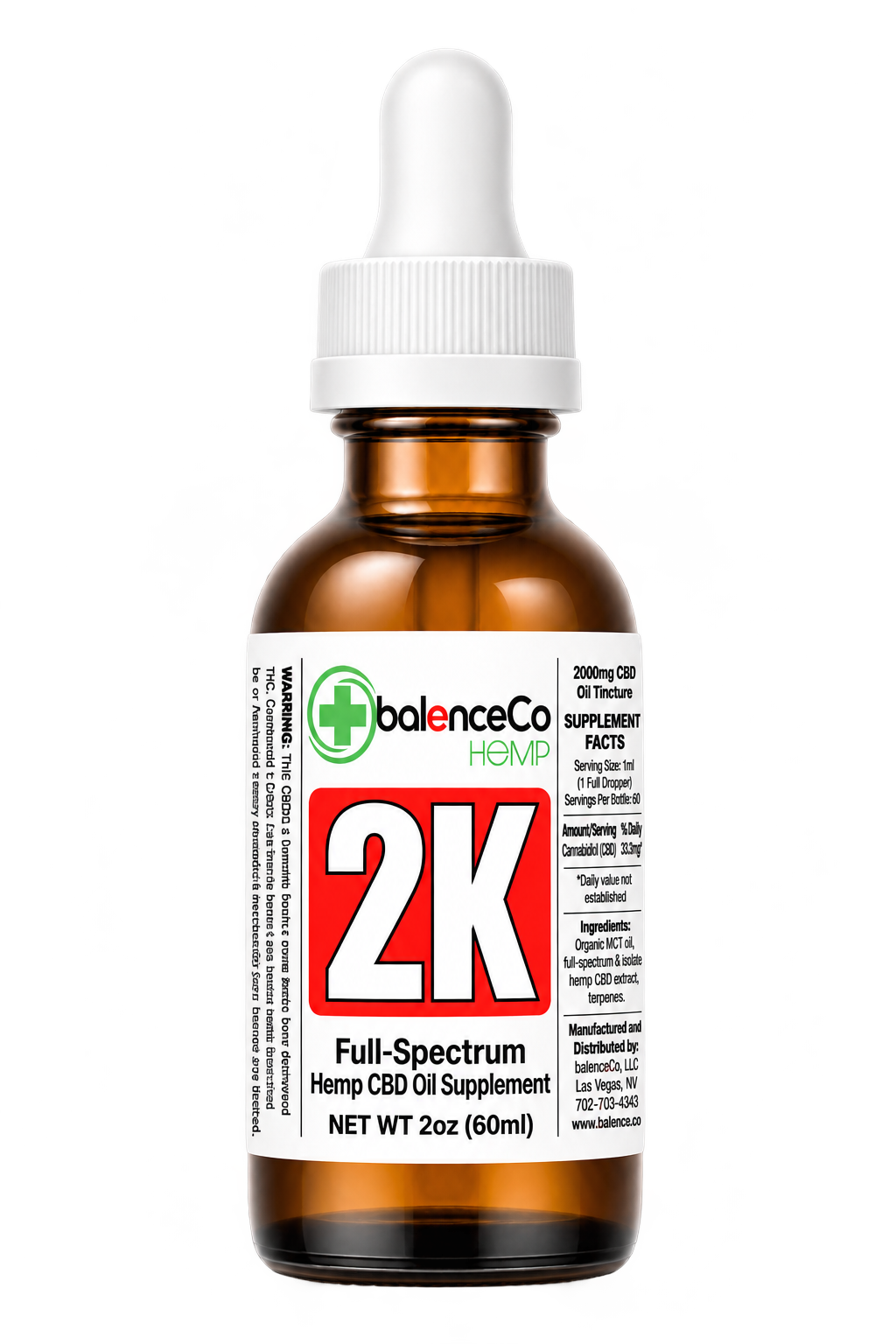
balenceCo 2K Full-Spectrum Tincture
2 oz / 60 mL
One 2K tincture bottle. Sixty servings.
Our pictured 2K tincture contains 2,000 mg of CBD in a 60 mL bottle. To show the new THC limit, imagine its contents had just 0.1 mg of THC per 1 mL dropper.
Illustrative calculation only: The 0.1 mg THC amount is hypothetical, not a lab result for this product.
1 mL dropper
per bottle
entire bottle
Even a small amount per serving adds up across the bottle. That’s why we are moving away from THC-containing full-spectrum extract.
Why can this affect ordinary full-spectrum CBD?
CBD itself is not capped at 0.4 mg. Many full-spectrum extracts include some THC alongside CBD. Under the new definition, it is the counted cannabinoids in the entire finished container that matter, regardless of whether the product is advertised as intoxicating. [3]
The extracts
Understanding the change in CBD
Here’s how our original Full Spectrum extract compares with the Broad Spectrum distillate and CBD Isolate we’re transitioning to.
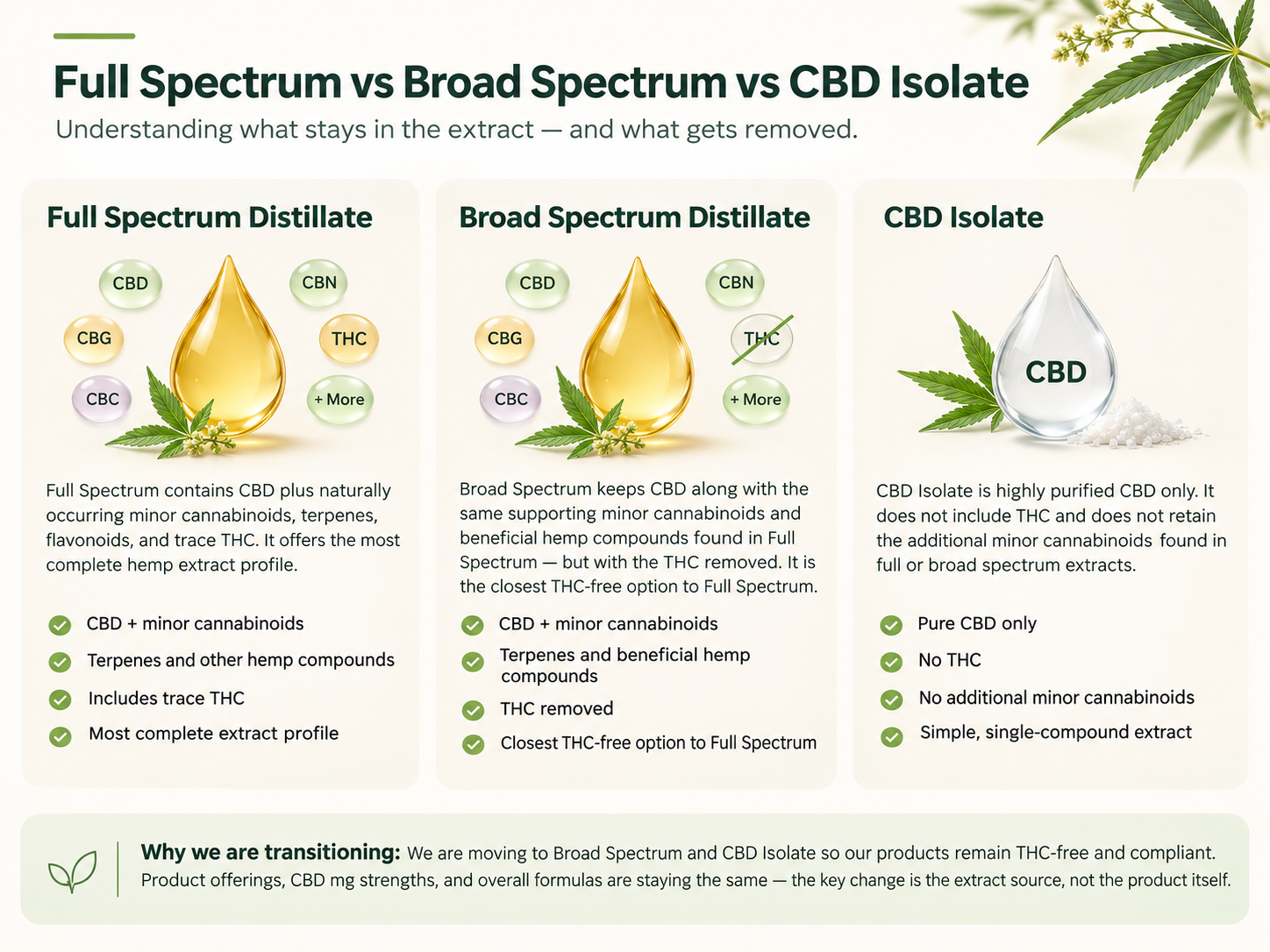
Exact minor-cannabinoid profiles vary by extract and batch. Finished-product testing and other applicable requirements—not the extract name alone—determine compliance.
Read it for yourself
What’s law—and what could change it.
The two public laws above govern the current timeline. The measures below are proposals, not enacted replacements in the records reviewed for this update. Bill links include the introduced text and a route to check subsequent actions.
S. 5736 · Hemp Guardrails Act
Sens. Tim Sheehy and Amy Klobuchar introduced another federal framework for hemp-derived consumer products. Their published overview describes age restrictions, testing and packaging requirements, limits on certain cannabinoids and inhalable flower, and provisions for qualifying CBD products. It is a proposal—not a new extension of the deadline.
Repeal or delay Section 781
H.R. 6209 · American Hemp Protection Act of 2025
Rep. Nancy Mace · Proposal
Would repeal Section 781, effective back to November 12, 2025. This is the direct repeal proposal.
H.R. 7024 · Hemp Planting Predictability Act
Rep. James Baird · Proposal
Would replace the original one-year implementation period with three years from enactment—November 12, 2028. The Senate counterpart is S. 3686, sponsored by Sen. Amy Klobuchar.
Alternative definitions and regulatory frameworks
H.R. 9830 · Lawful Hemp Protection Act
Rep. Andy Barr · Proposal
Would repeal Section 781 and establish a different framework, including a 1% total-THC hemp definition, restrictions on synthetic cannabinoids, age requirements and FDA oversight. This would not mean unlimited THC in retail products.
H.R. 7212 · Hemp Enforcement, Modernization, and Protection Act
Rep. Morgan Griffith · Proposal
Would create an FDA framework for cannabinoid hemp products, including oral, inhalable and topical products, with manufacturing, testing, labeling, registration and cannabinoid-content standards.
S. 3474 · Cannabinoid Safety and Regulation Act
Sen. Ron Wyden · Proposal
Would establish a federal system for regulating cannabinoid products, including product standards and provisions addressing cannabinoid beverages. Its proposed limits and categories should not be confused with the enacted 0.4 mg rule.
S. 4315 · Hemp Safety Enforcement Act
Sen. Rand Paul, with Sens. Amy Klobuchar and Joni Ernst · Proposal
Would create a process for states and Tribal governments to use qualifying alternative hemp definitions. State permission alone does not currently replace the federal definition.
Related proposals with a different focus
H.R. 10079 · Beverage Regulatory Parity Act
Rep. Beth Van Duyne · Proposal
Would establish a separate regulatory approach for hemp-derived beverages. A beverage-focused exception would not automatically resolve the rules for tinctures and gels.
H.R. 9913 · Safe Sips Act of 2026
Rep. Nick LaLota · Proposal
Would require a packaging identification system for certain intoxicating drinks. This is a drink-labeling proposal, not a general repeal of Section 781 or a broad CBD exemption.
S. 5022 · Cannabis Administration and Opportunity Act
Sen. Cory Booker · Proposal
A much broader proposal to decriminalize and deschedule cannabis and establish related regulation, taxation and other reforms. It is not an enacted change to today’s hemp deadline.
These are selected measures, not a prediction of which bill will pass. Proposed text can change through amendments, and an introduction or committee referral is not enactment.
A few practical questions
What customers should know.
Does this ban CBD itself?
Does “THC-free” or “non-detect” guarantee compliance?
No. “Non-detect” means the lab did not detect an analyte above its stated detection limit; it does not establish absolute zero. Reviewing the test method, detection limits, covered cannabinoids and total product quantity matters when evaluating a very small per-container threshold. A label description is not a substitute for that review. [9]
Could a different extract feel different?
Yes. Broad Spectrum and isolate have different cannabinoid profiles from Full Spectrum. Although the CBD strengths are staying the same, an identical experience or result cannot be guaranteed.
What about a product I already own?
Do not assume that buying before a deadline creates a permanent exemption. Section 781 and the partial-delay provision do not provide a general consumer grandfather clause for existing bottles. How the law applies depends on the product and relevant federal and state rules. This page is not an individual possession or legal-use determination. [1] [2] [4]
Has FDA clarified every detail?
No complete implementation answer is assumed here. CRS reported on October 28, 2026 that FDA had not yet published the cannabinoid lists and additional container information directed by Section 781. That statement is dated to the CRS report; it is not a claim that no later guidance can exist. [3]
Sources, not speculation
Go straight to the documents.
Legal summaries above are paraphrases. The enacted laws control; congressional research explains context. Each bill above has its own source links.
- Public Law 119-37 · Division B, Section 781 ↗. November 12, 2025; 139 Stat. 558–560. Original amendments, scope, exclusions and FDA publication directions.
- Public Law 119-103 · Section 2019 ↗. September 2, 2026. Enacted partial delay through December 11, 2026.
- CRS LSB11496 · Delay in Changes to Hemp Definition ↗. October 28, 2026. Congressional Research Service report, reproduced by EveryCRSReport.
- CRS LSB11381 · Legal Considerations Under the Controlled Substances Act ↗. December 22, 2025. Legal consequences and exclusions; its original effective-date discussion predates the later partial delay.
- CRS IF13136 · Hemp Definition and Agricultural Policy ↗. September 28, 2026. Definitions, thresholds and congressional options.
- 7 U.S.C. § 1639o · Hemp definitions ↗. Statutory wording and amendment notes; read the effective-date provisions together with source 2.
- FDA · Cannabis and Cannabis-Derived Products, Including CBD ↗. Separate FDA requirements for consumer products, foods, dietary supplements and cosmetics.
- New York Office of Cannabis Management · Educational presentation (PDF) ↗. The “Know the Difference” slide illustrates full-spectrum, broad-spectrum and isolate terminology; this is not a federal compliance standard.
- Oregon Liquor and Cannabis Commission · Hemp Registry Guide ↗. See “Claims Related to THC Content” for the explanation of non-detect results and THC-free claims. Cited for testing terminology, not as a statement of nationwide labeling rules.
Questions? We’re here to help.
Contact us if you would like help understanding the transition or the extract used in a particular product.
Information reviewed November 19, 2026. This page provides general information, not legal or medical advice. Laws and guidance can change. THC-free extract descriptions are not a substitute for product-specific testing or evaluation of applicable federal and state requirements.